
How Stress Affects Posture: The Nervous System’s Role in Spinal Health
- Dr Xavier Mirouze

- 3 days ago
- 6 min read

What if your slumped shoulders or that persistent neck tension isn't a sign of a broken body, but actually a brilliant strategy your nervous system uses to protect you? Many of us in Sydney spend our workdays feeling physically "armoured" or unable to relax. With recent data showing over 87 percent of Australian adults experience back pain, it's natural to wonder exactly how stress affects posture and why we can't just "sit up straight" when we're feeling overwhelmed.
In clinical practice, I often see how these physical patterns are your body's way of navigating a busy life. This article explains how your system adopts specific shapes as a stress-response strategy and how gentle chiropractic care may support a more relaxed physical presence. We'll explore the science of spinal health and how moving toward a state of ease can improve your vitality and overall sense of wellbeing.
Table of Contents
The Science of Spinal Tension: How Stress Shapes Your Posture
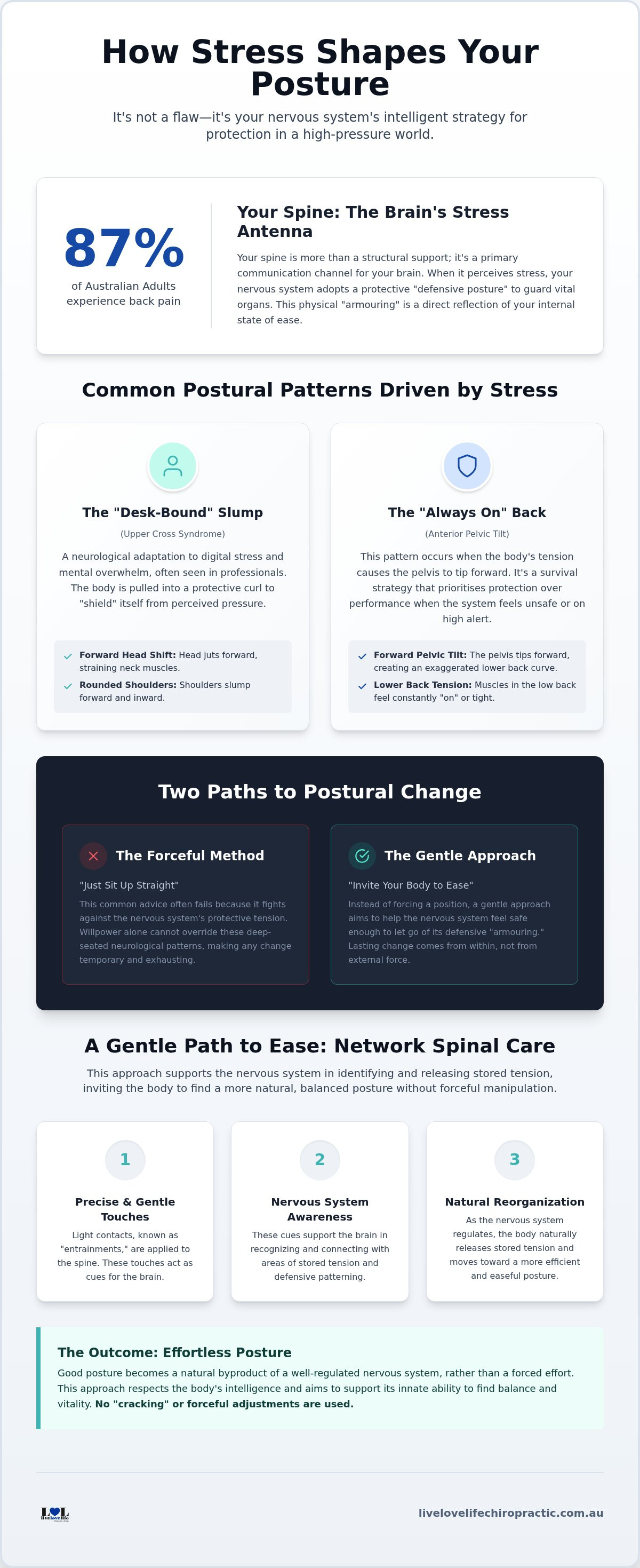
Your spine is more than just a stack of bones; it functions as a primary antenna for your brain. It constantly scans your environment for safety or threat. When we look at The Science of Spinal Tension, it becomes clear that how stress affects posture is actually a sophisticated neurological response. In clinical practice, I often see the body adopt what I call a "defensive" posture. This isn't a mistake. It's your nervous system's way of guarding vital structures like your heart and throat from perceived pressure.
When you feel "wound up" for long periods, your nervous system health dictates your physical shape. This often leads to chronic "armouring" in the neck and shoulders, a pattern I frequently observe in those managing high-pressure roles. Instead of your body feeling like a fluid, vibrant system, it starts to feel like a rigid shield. Your postural set-point isn't just a habit you can think your way out of; it's a reflection of your internal state of ease and how stress affects posture over time.
The Fight-or-Flight Response and Your Spinal Alignment
When the brain detects stress, it releases chemicals like cortisol and adrenaline. These hormones prime your body for action, often causing the psoas and spinal extensors to tighten instantly. This is part of the "startle response," a survival strategy that pulls the body into a forward-head or slumped position. I want you to know that your body isn't broken. It's simply stuck in a protective loop, trying to keep you safe in a high-pressure world. Understanding this is the first step toward finding a more relaxed presence.
Common Stress Patterns: From Upper Cross to Anterior Pelvic Tilt
One pattern I often notice in Woollahra professionals is the "desk-bound" slump. Your body isn't just being lazy; it's adapting to digital stress and mental overwhelm. This often manifests as Upper Cross Syndrome, where the shoulders round and the head shifts forward. It's a neurological adaptation that shows exactly how stress affects posture by pulling you into a protective curl. In clinical practice, I see this as a sign that the brain is trying to "shield" the front of the body from the pressures of a busy work week.
We also see how stress may influence posture patterns like Anterior Pelvic Tilt (APT).
This is where the pelvis tips forward under tension, often feeling like your lower back is always "on." Research into Postural Balance shows that our physical shape is deeply linked to our internal state. These patterns are simply your body’s way of managing a heavy load when it doesn't feel fully safe or at ease. It's a survival strategy that prioritises protection over performance.
Why "Sitting Up Straight" Rarely Works for Long-Term Change
Many people try to force a new position, but this often fails because the underlying nervous system tension remains. It's difficult to override how stress affects posture through willpower alone. Traditional stretches can feel like a temporary band-aid for a deeper structural pattern. To find lasting ease, we first need to identify the root holding patterns through a neurostructural examination. If you're curious about your own patterns, you might consider booking a posture assessment to see what your body is communicating.
A Gentle Path to Ease: How Network Spinal Care Supports Postural Balance
At Livelovelife Chiropractic, we specialise in Network Spinal care, which is a gentle, non-invasive approach to spinal health in Woollahra. This method uses precise, light touches known as "entrainments" to support the brain in identifying and releasing stored spinal tension. In clinical practice, we find that as the nervous system regulates, the body naturally moves toward a more neutral, easeful posture. This approach avoids forceful manual manipulation, making it ideal for those who prefer a more nurturing experience without any "cracking."
Understanding how stress affects posture is the first step toward reclaiming your physical ease. When your body no longer feels the need to "armour" itself against daily pressures, good posture becomes a natural byproduct rather than a forced effort. This approach helps you see how stress affects posture as a reversible strategy rather than a fixed habit. It's about teaching your system that it's safe to let go of the defensive patterns it has been holding.
Inviting Change Rather Than Forcing It
This care aims to help the body reorganise itself into a higher state of function and vitality. For busy residents across Paddington and Double Bay, daily life can be demanding. We often develop a personalised wellness care program to help you maintain this new sense of balance. We encourage you to consider how your environment and stress levels are influencing your physical presence. Your body has immense untapped potential; we're simply here to help you find the way back to it.
Reclaiming Your Natural State of Ease
Your body is a dynamic system with an incredible capacity for change. We've explored how your spine acts as an antenna for stress and why "armouring" is a protective strategy rather than a sign of being broken. Understanding how stress affects posture allows you to move away from forcing change and toward inviting ease through gentle nervous system regulation.
Dr. Xavier Mirouze brings over 23 years of clinical experience to our Woollahra practice. We're dedicated to helping residents across the Eastern Suburbs find a more relaxed, vibrant physical presence through our gentle, non-forceful approach. It's about supporting your body as it reorganises into a state of higher function and vitality.
We look forward to partnering with you on this journey toward a more balanced and energetic future. Your body's potential is waiting to be explored.
Frequently Asked Questions
How do I know if my poor posture is caused by stress?
You can often tell your posture is influenced by stress if you feel physically "wound up" or notice your shoulders creeping toward your ears during a busy day in Woollahra. This is a clear sign of how stress affects posture through a protective neurological loop. If your tension persists even after you try to relax, your body may be stuck in a defensive pattern.
Can gentle chiropractic care help with posture without cracking my back?
Absolutely. We specialise in a gentle method that focuses on nervous system regulation instead of aggressive manual adjustments. This approach aims to support the body in releasing stored tension through light, precise touches. Many of our members in the Eastern Suburbs prefer this nurturing style because it invites the body to relax without the need for forceful spinal cracking or manipulation.
What is a neurostructural examination and why is it important for posture?
This assessment is a deep dive into how your brain and spine communicate. Instead of just looking at where it hurts, we evaluate how your nervous system organises your physical shape. This is vital for posture because it identifies why your body feels the need to "armour" itself. It allows us to create a personalised plan that addresses your specific structural holding patterns.
How long does it take for the nervous system to release postural tension?
While everyone’s journey is different, most people notice a greater sense of ease within their first few sessions. Releasing chronic postural tension is a process of teaching your nervous system that it no longer needs to stay in a defensive state. As your system learns to reorganise, you may find that a more neutral and relaxed physical presence becomes your new natural baseline.


Comments