
Understanding Posture Patterns: A Guide to Spinal Health and Nervous System Balance
- Dr Xavier Mirouze

- 24 hours ago
- 7 min read

What if those rounded shoulders and that persistent tightness in your neck aren't just habits of sitting at a desk, but actually a physical map of how your body is navigating stress? In clinical practice, I often notice that many residents across Woollahra and Double Bay feel permanently "wound up" even while resting; it's a common experience in our fast-paced corner of Sydney. You've likely tried to force yourself to sit up straighter, only to find your body reverting to those familiar posture patterns the moment you stop thinking about it.
This article explores how your physical alignment reflects the internal state of your nervous system and why your body might be holding onto tension as a form of protection. We'll show you how a gentle, nervous-system-led approach may contribute to lasting structural harmony, helping you feel more energetic and naturally upright. By understanding the root cause of your tension, you can move toward a life of greater ease and peak capacity without the constant struggle of manual correction.
Table of Contents
Understanding Posture Patterns: More Than Just Slouching
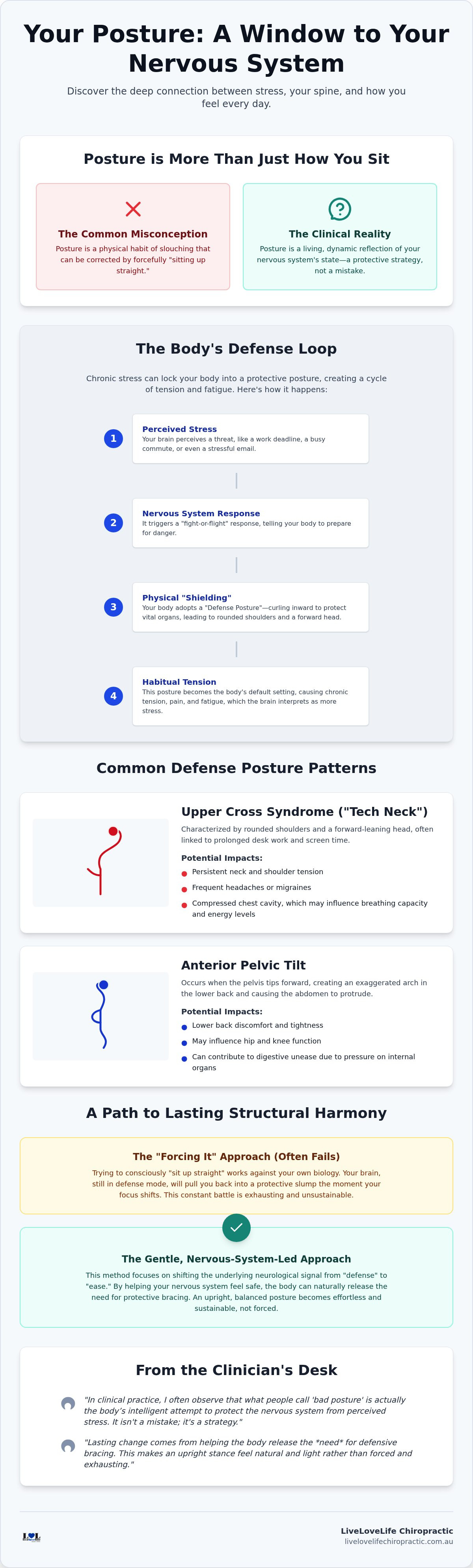
Many people view posture as a static frame, much like the structural beams of a house. However, your posture is actually a living, breathing reflection of your nervous system. It's a dynamic signal that shows whether your body feels safe and at ease or is currently in a state of defense. In clinical practice, I often observe that what people call "bad posture" is actually the body’s attempt to protect the nervous system from perceived stress. It isn't a mistake; it's a strategy.
A healthy Spinal posture relies on maintaining the natural S-curve of the back. This specific alignment is vital because it supports efficient energy flow and allows your internal organs to function without unnecessary pressure. When these posture patterns shift into a slump or a lean, it often indicates the body is trying to "brace" against life's demands. Understanding this shift is the first step toward reclaiming your vitality.
Neurological Root: Posture is a neurological expression, not just a muscular one.
Stress Response: Chronic stress drives the specific shapes our bodies take.
Gentle Support: Gentle care aims to shift the underlying signal from defense to ease.
The Nervous System Connection
Your brain is constantly scanning your environment for safety. If it perceives a threat, whether that's a looming deadline in Paddington or a busy commute through Woollahra, it may trigger a physical "shielding" response. This often manifests as a "Forward Head Posture" pattern. The body physically moves into a defensive crouch to protect the vital structures of the neck and throat, even if the "threat" is just a stressful email. Over time, these posture patterns become the body's default setting.
Why "Sitting Up Straight" Rarely Works
Conscious effort often fails because you're fighting your own biology. When your underlying neurological tone is set to "defense," your brain will pull you back into a slumped position as soon as your attention wanders. It's simply trying to keep you safe. To find lasting change, we must look at stress and the nervous system. Regulating this internal "software" helps the body release the need for defensive bracing. This makes an upright stance feel natural and light rather than forced and exhausting.
Common Posture Patterns and Their Impact on Your Vitality
We often see the body settle into specific, recognizable shapes when it is under long-term pressure. One of the most frequent posture patterns I see is "Upper Cross Syndrome." This involves rounded shoulders and a forward-leaning head, which places significant strain on the delicate structures of the upper spine. One pattern I often notice in our Woollahra practice is the "Tech Neck," which can contribute to neck and shoulder tension and even headaches.
Lower down the spine, "Anterior Pelvic Tilt" may influence lower back comfort and even digestive ease. This happens when the pelvis tips forward, creating an exaggerated arch in the small of the back. These physical shifts aren't just about how you look in the mirror. They can compress the chest cavity, which may influence breathing capacity and leave you feeling fatigued by mid-afternoon. Following a Guide to Good Posture can help you identify these posture patterns early before they become your body's default setting.
The "Defense Posture" Explained
When your nervous system stays in a state of fight-or-flight, your spine often adopts what we call a "Defense Posture." This is a physical manifestation of stress where the body curls inward to protect its most vulnerable parts. Over time, this chronic tension in the spinal cord may lead to recurring aches and pain. It’s as if your body is stuck in a protective loop that it doesn't know how to switch off, even when you're at home trying to relax.
Posture and the Eastern Suburbs Lifestyle
Our local environment in the Eastern Suburbs often reinforces these defensive shapes. Long commutes from Bondi or high-pressure desk jobs in the CBD frequently mean hours spent in a seated, forward-leaning position. This "always-on" culture creates a cycle where mental stress and physical bracing feed into each other. If you feel your body is stuck in these habits, a comprehensive posture assessment can be a helpful way to map your current state and find a path toward greater ease.
Beyond Stretching: Supporting Postural Balance Through Gentle Care
While many people turn to yoga or basic stretching to address a slouch, these methods often only touch the surface. If your nervous system is still signalling "defense," your muscles will likely pull you back into those familiar posture patterns as soon as you step off the mat. At our practice, we use Network Spinal care to address the neurological "software" that dictates your physical shape. This approach uses gentle "entrainments" to support the body in releasing stored tension, all without the need for forceful cracking or manual manipulation.
In my 23 years of experience, I have seen that when we address the nervous system first, the body often naturally begins to seek a more upright, balanced posture. It's about helping the brain realize that the old defensive bracing is no longer necessary. To understand your specific needs, we start with a comprehensive neurostructural examination. This process allows us to map your unique patterns and create a path toward greater ease. You can also Improve Your Posture for Better Health by learning how mental states and physical habits intertwine.
The Livelovelife Approach to Posture
Our initial assessment process in Woollahra is designed to be a supportive partnership. We don't just look at where it hurts; we look at how your whole system is functioning. This allows us to move away from simple "pain management" and toward a vision of wellness and vitality. We want to see you moving through Paddington or Bellevue Hill with a sense of lightness and presence, feeling supported by your own internal structure.
Practical Steps for Sydney Residents
You can support your progress at home by taking regular "nervous system breaks" throughout your workday. Simply pausing to breathe and acknowledge your surroundings can help interrupt the defense posture. We also recommend proactive posture assessments for the whole family, as children often pick up the same physical habits as their parents. If you're ready to see how your body can feel when it's truly balanced, please book your initial consultation to discover your unique posture patterns.
Embracing a Future of Greater Ease and Natural Alignment
Your body is a vibrant, living system that is always doing its best to support you. By understanding that your posture patterns are actually a physical map of your nervous system's history, you can stop fighting against your frame and start working with it. We have explored how chronic stress often leads to defensive bracing and why gentle care is so vital for updating your internal "software."
In our practice, we bring over 23 years of clinical experience to every visit. We focus on a gentle, non-invasive Network Spinal approach that honors your body's wisdom rather than forcing it to change. Through our comprehensive neurostructural examinations, we aim to help you move from a state of protection into a state of growth and vitality.
We believe every individual has immense untapped potential for health and harmony. It is our privilege to partner with you as you rediscover a version of yourself that feels more upright, energetic, and truly at ease in the world. We look forward to welcoming you and your family into our nurturing environment soon.
Frequently Asked Questions
Can I really change my posture after years of slouching?
Yes, your body remains a dynamic system with a remarkable capacity for adaptation throughout your entire life. While years of certain habits can set deep posture patterns, gentle care aims to support the nervous system in finding a new, more efficient default. It isn't about forcing a "correct" shape but rather helping your brain feel safe enough to release the protective bracing it has held for so long.
Why does my back hurt when I try to sit up straight?
This discomfort usually happens because you are using conscious muscular effort to override a nervous system that is stuck in a "defense" signal. When your spinal cord is under tension, forcing an upright position can feel like stretching a tight spring. We find that when the underlying neurological tone is addressed first, sitting upright begins to feel like a natural state of ease rather than a tiring chore.
How is Network Spinal different from traditional chiropractic for posture?
Network Spinal care moves away from traditional manual spinal manipulation and forceful adjustments. Instead, we use very gentle touches called "entrainments" at specific points along the spine. This approach aims to help your brain recognize and release its own tension patterns. It is a collaborative process that focuses on long-term structural harmony and nervous system resilience rather than just temporary relief.
How many sessions does it take to see a change in my posture patterns?
Every individual's journey is unique, as your body responds to the specific stressors of your lifestyle in the Eastern Suburbs. In clinical practice, I often observe that many people begin to feel a shift in their posture patterns and overall energy within the first few weeks of consistent care. We use our initial neurostructural examination to map your progress and ensure your care plan aligns with your personal wellness goals.


Comments