
Upper Cross Syndrome in Woollahra: Understanding the iHunch and Your Vitality


What if that persistent tightness in your shoulders isn't just a sign of a long day at the office, but a signal that your nervous system is struggling to keep you in balance? Many of our neighbors in Woollahra find themselves trapped in a pattern known as upper cross syndrome, where the head drifts forward and the shoulders round inward. Research shows that for every 2.5 centimeters your head moves forward, it adds nearly 4.5 kilograms of extra weight for your neck to support. You likely know the feeling of a heavy neck or a dull tension headache that sets in by 3:00 PM every afternoon. It's exhausting to feel like you're fighting your own body just to sit up straight, especially when you want to feel vibrant and present.
We believe your body is a brilliant system with immense untapped potential for healing and vitality. You don't have to stay stuck in a slumped posture that drains your energy and restricts your breathing. This article will show you how gentle, nurturing care can restore your natural alignment and help you thrive. We'll explore why this "iHunch" happens and provide a clear, supportive path toward long-term relief and a more connected, energetic version of yourself.
Key Takeaways
Learn how the "iHunch" or upper cross syndrome creates a specific pattern of muscle imbalance that impacts your daily vitality and comfort.
Understand why your posture serves as a window into your nervous system, signaling whether your body is stuck in a persistent state of stress.
Identify the unique signs of postural fatigue that affect busy professionals and active residents across Woollahra, Bondi Junction, and Paddington.
Discover how gentle Network Spinal care offers a nurturing, touch-based alternative to traditional adjustments for restoring your natural alignment.
Embrace a holistic path toward wellness that views your body as a system of untapped potential rather than a machine needing repair.
Table of Contents What is Upper Cross Syndrome? Defining the Modern iHunch Beyond Muscles: The Nervous System Connection Identifying Upper Cross Syndrome in Your Sydney Lifestyle A Gentler Path to Alignment in Woollahra
What is Upper Cross Syndrome? Defining the Modern iHunch
At Live Love Life Chiropractic, we believe your body is a masterpiece of potential, designed to move with ease and grace. However, the demands of a modern lifestyle often pull us out of our natural alignment. You might recognize it as the "iHunch" or "Tech Neck," terms that describe the physical toll of our digital age. Technically known as Upper Crossed Syndrome, this condition is a specific pattern of muscle imbalance that develops in the neck, shoulders, and chest. It's especially common among our Woollahra community members who spend long hours at desks or looking down at smartphones. Upper cross syndrome is a postural pattern that compromises spinal health and vitality.
When your body is stuck in this shape, it affects more than just your silhouette; it impacts your energy levels and your ability to engage fully with the life you love. Instead of your nervous system focusing on growth and repair, it's forced to manage the constant mechanical stress of an unbalanced frame. Recognizing the signs is the first step toward reclaiming your vibrancy and ensuring your body stays as a supportive partner in your daily adventures.
The Anatomy of the Cross
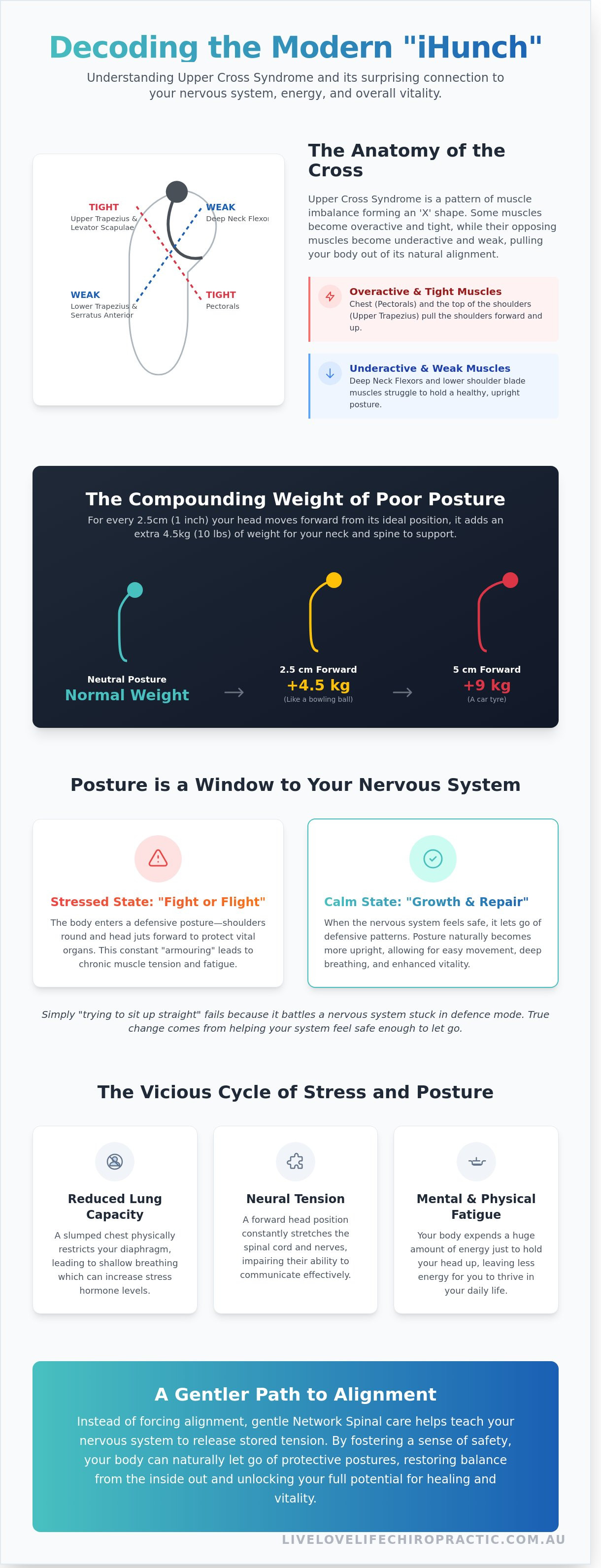
The name comes from the way these imbalances intersect in your body, forming an "X" shape when viewed from the side. On one side of the cross, muscles become overactive and tight. On the other side, key supporting muscles lose their tone and become underactive. This creates a cycle where your body works against itself rather than moving in harmony.
The Tight Side: Your pectorals (chest muscles) and upper trapezius (top of the shoulders) hold onto excessive tension, pulling your frame forward and closing off the chest.
The Weak Side: Your deep neck flexors and the muscles around your lower shoulder blades lose their tone, making it difficult to maintain a healthy, upright posture.
This imbalance creates the characteristic rounded shoulders and forward head posture that many of us see in the mirror. It's a clear signal that your body is adapting to stress rather than staying in a state of ease. By understanding the mechanics of upper cross syndrome, we can begin the journey of returning your body to its natural state of balance and connection, helping you thrive in every aspect of your life.
Beyond Muscles: The Nervous System Connection
At Live Love Life Chiropractic, we believe your posture is a beautiful window into how your nervous system processes the world around you. When upper cross syndrome takes hold, it's often more than just a physical habit. It's a sign that your body may be trapped in a persistent state of "fight or flight." This defensive stance rounds the shoulders and tucks the chin to protect your most vital areas. While many people focus on the symptoms and treatments for Upper Crossed Syndrome through simple stretching, these efforts often fall short. If your brain still perceives a threat, it will continue to "armour" your body by tightening those same muscles back up.
True vitality comes from addressing this underlying tension. Without calming the nervous system, "trying to sit up straight" feels like an exhausting uphill battle against your own biology. This is why our approach focuses on nervous system regulation chiropractic care. We want to help your system feel safe enough to let go of these protective patterns, allowing you to move with ease and grace once again.
The Vicious Cycle of Stress and Posture
A forward head position does more than strain your neck; it places a massive workload on your spinal cord and delicate nerves. Research indicates that for every 2.5 centimetres your head shifts forward, it adds nearly 4.5 kilograms of effective weight to your upper back and neck. This constant strain creates a cycle that impacts your whole life:
Reduced Lung Capacity: A slumped chest restricts the diaphragm, leading to shallow breathing that further triggers stress hormones.
Neural Tension: Stretched nerves cannot communicate at their full potential, affecting your overall energy and vibrancy.
Mental Fatigue: When your body is constantly working to hold your head up, you have less energy left to thrive in your daily life.
Breaking this cycle requires more than just willpower; it requires a shift in how your body communicates with itself. If you feel like your posture is holding you back, our team is here to help you find a path toward better connection. You can book a consultation with us to begin your journey toward lasting alignment and health.
Identifying Upper Cross Syndrome in Your Sydney Lifestyle
Living in the Eastern Suburbs often means a fast-paced, high-performance life. You might feel a heavy, draining fatigue after a productive day at your Bondi Junction office, even if you spent most of it sitting. This exhaustion often stems from upper cross syndrome. It is not just a result of tired muscles; it is a sign that your nervous system is working overtime to compensate for a structural imbalance. Your body is a system with immense untapped potential, but persistent postural strain can cloud your natural vibrancy.
Many active residents in Paddington or Rose Bay find this condition confusing. You might attend Pilates classes three times a week or walk the coastal trails, yet your shoulders still feel locked in a forward roll. Regular exercise is wonderful for your heart, but it does not always undo the specific neurological patterns created by hours of focused desk work. If your body feels "tight" despite your best efforts to stay fit, your alignment might be the missing piece of the puzzle.
You can perform a simple "Side-View Test" at home to check your connection. Stand naturally in front of a full-length mirror and look at your profile. If your ear hole sits forward of the center of your shoulder, or if your knuckles face the mirror instead of your palms facing your thighs, you are likely experiencing upper cross syndrome. Beyond physical pain, look for these common signals:
Persistent jaw tension or clenching during the day.
A sense of "brain fog" that makes focusing on complex tasks difficult.
A 15% to 20% reduction in how far you can comfortably turn your head.
Shallow breathing that stays in the upper chest.
Environmental Triggers in the Eastern Suburbs
Sydney’s vibrant cafe culture is a gift, but "laptop working" from a small marble table in Woollahra often forces your spine into a collapsed C-shape. Long commutes or carrying heavy bags over one shoulder also shift your center of gravity. For young families, "baby-wearing" for several hours a day can accelerate these patterns if your spine isn't supported. Your health is your greatest asset, and small ergonomic shifts can protect it. Raising your screen so the top third is at eye level can reduce the effective weight on your neck by up to 12 kilograms. We are here to help you reclaim your vibrant alignment and thrive in your daily life.
A Gentler Path to Alignment in Woollahra
At Live Love Life Chiropractic, we believe your journey to wellness should feel as nurturing as the results themselves. If you're struggling with upper cross syndrome, you might expect heavy manual adjustments or forceful "cracking." However, our Woollahra team utilizes Network Spinal care, a transformative, touch-based approach. This method focuses on releasing deep spinal tension without the need for high-velocity thrusts. We use gentle contacts, known as entrainments, to help your brain recognize and release its own patterns of stress.
Traditional corrections often focus on the bones, but we focus on the nervous system. When the body is in a state of "iHunch," it's often in a defensive, bracing posture. Forceful adjustments can sometimes cause the body to brace further. Gentle entrainments are often more effective for long-term postural shifts because they teach the body to self-correct. According to a landmark study of 2,818 patients published in the Journal of Alternative and Complementary Medicine, 76% of participants reported significant improvements in their physical, emotional, and life enjoyment through this style of care. We move you from "correction" to "connection," helping your body find its own natural, healthy rhythm.
Your journey begins with a comprehensive neurostructural examination at our Woollahra wellness studio. During this session, we assess:
Your spinal alignment and how it relates to your "Crossed" posture.
Nervous system tension levels using non-invasive technology.
Structural shifts that may be draining your daily energy.
Your unique breath and movement patterns.
Restoring Your Body’s Potential
Releasing the upper cross syndrome pattern does more than just straighten your shoulders; it unlocks a new level of vibrancy. When your nervous system isn't constantly fighting gravity, that redirected energy fuels your life. You'll likely feel more present for your family and more focused during your workday. We don't believe in one-size-fits-all solutions. Our team creates a personalised care plan tailored to your unique nervous system needs. Your body isn't a broken machine; it's a system with immense untapped potential. We're here to help you rediscover that inner strength and live your life to the fullest.
Rediscover Your Natural Vitality and Alignment
Your body is designed to thrive; it's not a machine destined to break down under the weight of a digital world. We've explored how the modern iHunch is more than just a slouch. It's a signal that your nervous system is adapting to the pressures of a busy Sydney lifestyle. By understanding upper cross syndrome, you're taking the first step toward reclaiming your posture and your energy. True health flows when we address the root cause of these patterns rather than just masking the symptoms.
At Live Love Life Chiropractic, we view your health as your greatest asset. Dr. Xavier Mirouze uses over 20 years of clinical experience in gentle care to help families find balance. Our specialized neurostructural examinations identify the specific source of your tension, providing a clear path back to wellness. We're located conveniently for those living in Woollahra, Bondi Junction, and Paddington who are ready to feel vibrant again.
Book your complimentary consultation in Woollahra today and start your journey toward a life of ease and connection. We can't wait to help you unlock your body's immense untapped potential.
Frequently Asked Questions
Can Upper Cross Syndrome cause headaches and migraines?
Yes, the forward head posture associated with upper cross syndrome often leads to persistent tension headaches and cervicogenic migraines. This misalignment places up to 13 kilograms of extra pressure on your cervical spine for every 2.5 centimetres your head moves forward. This strain irritates the delicate nerves and muscles at the base of your skull. By restoring balance to your nervous system, we help you regain your natural vitality and move away from the cycle of recurring pain.
How long does it take to fix Upper Cross Syndrome with chiropractic care?
Most people begin to feel a positive shift in their alignment within 4 to 6 weeks of consistent, nurturing care. Recovery is a unique journey that depends on how long your body has held these postural patterns. A 2021 study in the Journal of Physical Therapy Science suggests that 12 sessions of corrective care can significantly improve postural angles. We focus on your long-term potential, guiding your body toward a state where it can thrive and maintain its own vibrant health naturally.
Is it possible to have Upper Cross Syndrome if I am very active?
Yes, even highly active individuals in Woollahra can develop upper cross syndrome if their training routines focus heavily on chest muscles while neglecting the upper back. This muscular imbalance affects approximately 25 percent of regular gym goers who over-train their "mirror muscles." When your pectorals are too tight and your deep neck flexors are weak, your nervous system can't coordinate optimal movement. Our goal is to help you achieve a deeper connection with your body, ensuring your fitness supports your overall wellness.
What is the best sleeping position for someone with Upper Cross Syndrome?
Sleeping on your back with a contoured pillow that supports the natural curve of your neck is the most beneficial position for your spine. This position allows your shoulders to open up naturally and counteracts the slumped posture of the iHunch. If you prefer your side, ensure your pillow height keeps your nose aligned with your breastbone. Avoiding stomach sleeping is vital, as it rotates the neck for 7 to 8 hours, creating unnecessary stress on your nervous system and hindering your body's ability to recharge.
Can children or teenagers in Woollahra develop Upper Cross Syndrome?
Children and teenagers are increasingly susceptible to postural imbalances due to the 5 to 7 hours they spend daily on digital devices. We see many young people in our community experiencing "Tech Neck" which is a precursor to more permanent structural changes. Early intervention helps ensure their growing nervous systems stay clear and resilient. By focusing on alignment now, we're not just fixing a slump; we're empowering the next generation to grow up with full health potential and a vibrant sense of wellbeing.


Comments