
Why Your Back Pain Returns: Nervous System Care in Bondi
- Dr Xavier Mirouze

- Aug 12
- 6 min read

What if the reason your back keeps seizing up has less to do with your muscles and more to do with how your brain communicates with your body? It's incredibly frustrating to feel great after a treatment only to find yourself wondering, Why does lower back pain keep returning? just a few days later. In our high-pressure Sydney lifestyle, many of us push through tension until our bodies finally force us to stop. You aren't alone in feeling stuck in a cycle of temporary relief followed by the looming anxiety of "throwing out" your back again.
This article explores why conventional approaches might be missing a vital piece of the puzzle: your nervous system. We'll look at how shifting the focus from "fixing" a broken part to supporting your body's internal communication can help create a long-term strategy for health. You'll discover how a gentler approach to spinal care may help you break the cycle of recurrence and move toward a more vibrant, energetic future.
Table of Contents
Why Does Lower Back Pain Keep Returning? The Cycle of Recurring Tension
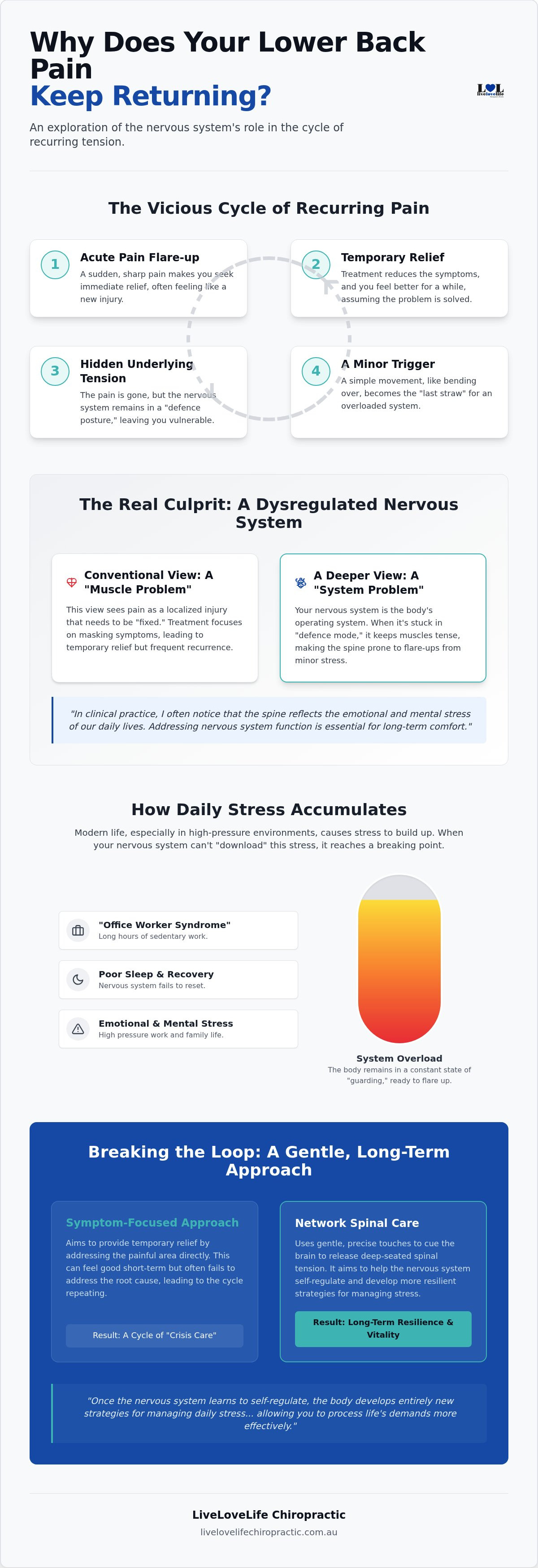
Many people view Low back pain as a single injury that simply hasn't healed. However, it's often more accurate to see it as a series of flare-ups. In clinical practice, I often notice that patients seek help when the pain is acute, but ignore the underlying tension that remains during "quiet" periods. This hidden tension is a primary reason ✓ Why does lower back pain keep returning? even after you think you've found relief.
Living in Sydney's Eastern Suburbs often involves a high-pressure lifestyle.
We frequently see a phenomenon called "load accumulation," where daily stressors from work and family life stack up until the spine reaches a breaking point. Your body can become stuck in a "defence posture" that hasn't been reset. This protective state leaves you vulnerable to the next minor movement, like picking up a shopping bag or leaning over a desk.
The Role of the Nervous System in Persistent Spinal Tension
Your nervous system acts as the operating system for your spine, managing everything from muscle tone to posture. When this system is dysregulated, it keeps your muscles in a state of constant "guarding." This protective bracing makes you feel stiff and prone to discomfort from even the simplest daily tasks.
One pattern I often notice is that the spine reflects the emotional and mental stress of our daily lives in Woollahra. Addressing stress and nervous system function is essential for long-term comfort. It's about helping your body transition from a state of survival back into a state of ease, allowing your system to function at its peak capacity.
Identifying Common Triggers for Recurring Lower Back Flare-ups
While many blame "bad posture," the reality is often a series of complex neurostructural adaptations. Your body instinctively shifts its weight to protect perceived weaknesses, a pattern we frequently see in Eastern Suburbs professionals facing "Office Worker Syndrome." These adaptations are heavily influenced by chronic low back pain risk factors like occupational stress and repetitive sedentary habits that build up over time.
Have you ever wondered ✓ Why does lower back pain keep returning? after a simple movement like picking up a pencil? That tiny movement wasn't the actual cause; it was simply the last straw for a system already under pressure. When we don't get enough quality sleep or recovery time, our nervous system fails to "download" the day's stress, leading to a state of constant overload.
How Your Body "Remembers" Stress and Previous Injuries
Your body possesses a remarkable memory for stress and physical trauma. It often creates a "splinting" effect around old injuries that may never have fully released. This creates a high-tone nervous system where your lower back muscles remain in a state of constant guarding, unable to fully relax even when you are resting.
Identifying these hidden patterns is the first step toward long-term comfort. We use a comprehensive neurostructural examination to find exactly where your system is holding onto the past. If you're ready to understand your body's unique patterns, you can schedule your nervous system assessment to start your path to wellness.
Breaking the Loop: A Gentle Approach to Long-Term Spinal Health
Breaking the cycle of recurrence requires more than just masking the symptoms. We use Network Spinal care, which is a gentle, non-invasive method aimed at regulating the nervous system. Instead of forceful cracking, this approach uses light, precise touches known as entrainments. These signals encourage the brain to release deep-seated spinal tension, providing a clearer answer to ✓ Why does lower back pain keep returning? by addressing the "software" behind the physical discomfort.
Our goal is to help your body move from a state of survival to one of ease. For many Eastern Suburbs residents, this means transitioning from "crisis care" to consistent wellness care. One pattern I often notice is that once the nervous system learns to self-regulate, the body develops entirely new strategies for managing daily stress. This shift allows you to process life's demands more effectively rather than letting tension accumulate until a flare-up occurs.
Your Path to Vitality in Woollahra and Beyond
Taking a proactive approach means addressing the nervous system before the next flare-up takes hold. A personalised wellness care programme focuses on maintaining long-term mobility and balance. When your nervous system is in a state of ease, your body has an immense capacity for structural harmony and growth. We invite you to explore this vibrant way of living, where your health is viewed as a positive lifestyle choice rather than just a response to pain.
Moving Toward Lasting Ease and Vitality
You've learned that recurring discomfort isn't just about a physical injury; it's often your nervous system's way of communicating a state of overload. By understanding how your body adapts to Sydney's high-pressure lifestyle, you can move from temporary fixes to a long-term strategy for health. We've explored how a gentle, non-invasive approach aims to support your system in releasing deep-seated tension. This shift in perspective provides a clear answer to ✓ Why does lower back pain keep returning? while opening the door to greater energy and structural harmony.
With over 20 years of clinical experience in Woollahra, we're here to guide you toward a more vibrant future. We believe your body has an immense capacity for growth when it's given the right support.
Frequently Asked Questions
Why does my back pain return even after I have rested it for weeks?
Rest often addresses the symptoms but misses the underlying neurological patterns. While rest allows inflammation to settle, it doesn't reset the "guarding" state of your nervous system. In clinical practice, I see that without addressing these patterns, the body remains primed for the next flare-up as soon as you resume normal activity.
Is it possible to have recurring back pain that isn’t caused by a disc injury?
Yes, many people experience persistent discomfort due to neurostructural tension rather than physical disc damage. This often involves the body creating a protective "splinting" effect around the spine. We focus on identifying ✓ Why does lower back pain keep returning? by assessing how your system manages internal tension and structural balance.
How does stress in my daily life contribute to my lower back seizing up?
Your nervous system directly controls muscle tone. One pattern I often notice is that emotional stress triggers a physical "defence posture" in the spine. When you're constantly under pressure, your muscles stay in a state of high tension. This cumulative load makes the lower back more susceptible to seizing up during busy periods.
What is the difference between gentle chiropractic and traditional spinal manipulation for recurring pain?
Gentle chiropractic, like Network Spinal care, uses light touches to cue the brain to release tension rather than using forceful manual adjustments. Instead of "cracking" the joints, we focus on regulating the nervous system. This approach aims to help the body develop sustainable internal strategies for managing stress and maintaining a state of ease.
Can my posture at my desk in Sydney CBD be the primary cause of my returning pain?
Desk posture is often a significant trigger, but it's usually the "last straw" for an already overloaded nervous system. Sitting for long hours in the Sydney CBD creates repetitive physical stress that your body must adapt to. Understanding ✓ Why does lower back pain keep returning? involves looking at how these daily habits interact with your system's overall resilience.
How many sessions does it typically take to see a change in recurring pain patterns?
Most individuals begin to notice subtle shifts in their body's tension and awareness within the first few visits. However, changing long-standing recurring patterns usually requires a consistent wellness care program over several weeks. Every person's journey is unique, and we tailor our approach to support your specific path toward lasting vitality and structural harmony.


Comments